 MusicBrainz
 Discogs
 Palestine
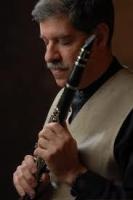 Suhail Khoury
Suhail Khoury is a composer and a ney and clarinet player who has helped transform the musical and cultural landscape of Palestine generally and East Jerusalem in particular by building institutions that have instilled love and passion for music in every home, as well as national pride in Arab cultural heritage.
Suhail Khoury was born in 1963 in Jerusalem, where he attended the Collège des Frères.
Khoury was raised in a family whose members were part of the cultural and social activism scene. His great aunt, Elizabeth Nasir, founded Jerusalem’s Rawdat El-Zuhur kindergarten. His mother, Samia Khoury, was president of the school for 17 years and is herself an educator and a social activist; she imparted to Khoury a passion for music and Palestinian culture.
His aunt, Rima Tarazi, is a Palestinian composer, and his mother’s cousin, Sumaya Farhat Nasir, is a peace activist and writer. Another cousin, Kamal Nasir, was a poet. His great-aunt, Nabiha Nasir, founded a girls’ school in 1924 that would later become the West Bank’s prestigious Birzeit University.
Love of Music, Love of Country
Khoury grew up listening to classical music giants such as Beethoven and Mozart. At four years of age, he would stand in front of his mother’s gramophone and wave his hand with the music, as if conducting an orchestra.4 According to Samia, her son was practically addicted to Mozart’s Eine Kleine Nachtmusik. At the Collège des Frères, Khoury joined the school band, Rainless Reindeers, as the clarinet player.
Alongside his love for music, Khoury was also brought up to love his country, serve its people, and value its freedom. There was no escaping the struggle engulfing his country: His cousin, the poet Kamal Nasir, had been assassinated by the Israelis in 1973, and his uncle Hanna Nasir, president of Birzeit University, had been deported in 1974 and lived in exile until April 1993, when he was one of 30 Palestinians Israel allowed to return during the Oslo negotiations.6 Love of country combined with passion for music and Jerusalem would inspire Khoury’s future activities and myriad contributions to Jerusalem.
Palestinian musician Suhail Khoury began his musical career playing the ney.
Education and Musical Training
When Khoury was growing up, pursuing a career in music was regarded as something appropriate for wedding celebrations or folklore celebrations but not something one studied or turned into a career. He recalls, “If someone was carrying an oud on their back in the 70s and 80s, the boys on the street would make fun of them.”
He studied Middle Eastern studies at Birzeit University and played the ney and clarinet for the university band. In the late 1970s, he also joined two bands in East Jerusalem: Friends of the Earth and al-Manar.
After that, his studies were more focused on music. He left for the United States and enrolled in the University of Iowa to study musicology and music performance from 1983 to 1985. Then he completed an MA in music at Kingston University in London.
Educator and Institution Builder
Khoury held several teaching positions. After completing his studies in the mid-1980s, he returned to Palestine and taught music at the Friends’ Girls’ School in Ramallah and the Hellen Keller School for the Visually Impaired in Jerusalem; he taught a ney course at Birzeit University that ran until 1987.
During this period, Khoury had a hand in establishing several musical groups, programs, and centers, all of which served to propel Palestinian musical heritage and culture into daily life. In all of his projects, Khoury seeks to promote music education and support young talent, lobbying for funding of musical programs, institutes, and cultural activities. In 1980, he co-founded the band Sabreen and served as its saxophone and ney player.8 This was still a time when the general attitude toward music as a career was unfavorable. According to Khoury, musicians were rarely paid, and concerts were funded by charities.
Then in 1987, he cofounded the Palestinian Popular Art Center in al-Bira and served as its director.10 In 1989, he cofounded al-Funoun Palestinian Popular Dance Troupe, which he went on to direct until 1993. Also in 1993, he founded both the Palestine International Festival of Music and Dance, acting as its general director, and the National Conservatory for Music (NCM), now known as the Edward Said National Conservatory for Music (ESNCM). The ESNCM, the first music school in Palestine, has had a profoundly significant impact on Palestine’s music scene: It started with only 3 part-time teachers and 40 students. Now it serves about 2,000 students and has seven branches across Palestine, including in Ramallah, Jerusalem (in partnership with the Jerusalem Society for Music Education and Research), and Bethlehem—as well as outreach programs in refugee camps, UNRWA schools, and elsewhere.
The core mission of the ESCNM is to “bring music to every Palestinian home.” The institution builds on a firm belief in “music as a form of national pride as well as a method of peaceful resistance.” Moreover the institution has invested both in preserving and developing Arabic musical heritage as well as developing skills and passionate commitment to classical Western music.
The ESNCM works in three broad areas: education, outreach (bringing choirs and instrumental lessons to communities that don’t have any music training), and building cultural infrastructure. Under its aegis, in Jerusalem and beyond, numerous ensembles, chamber groups, orchestras, jazz bands, and music camps have sprouted and flourished, all of which have helped to ignite public interest in music and build audiences. Among these are the Palestine Youth Orchestra (PYO), the Palestine Strings (comprised of the string players of the PYO), the Palestine National Orchestra, and the Arabic Orchestra. The 70-instrument Arabic Orchestra was the first Arabic ensemble in the world with such a large number and specific combination of instruments. Conducted by Khoury, the Arabic Orchestra specializes in playing Arabic music, much of which is written specifically for it, even as it also performs pieces from Palestinian and Arab heritage that have been specially arranged for the orchestra. Thus, the Arabic Orchestra also creates extensive professional opportunities for others working in music, such as composers and arrangers, and technicians and professionals, including sound and lighting technicians, designers, and photographers, not to mention volunteers.
In Jerusalem, the institute spearheaded Banat al-Quds, Daughters of Jerusalem, the all-female choir, established in 2013 and led by Khoury. The group includes 27 members who sing and play the flute, violin, bass, and qanun. They perform pieces by famous Arab composers, including music written by Khoury himself. One reviewer remarked, “Despite the oppression under which they live, these young women radiate in a powerful way joy, pride, hope and courage. Their songs are both a vision and a lament for the ancient city . . . . ‘Banat Al-Quds’ is an impressive choral album that sometimes sounds chilling, sometimes heartwarming.”
“We teach children to love Beethoven, Mozart, Sibelius, Bizet, Rossini, Albeniz, and all of the great European and world classical composers,” Khoury says. “But we also teach the music of Abdul Wahab, Rahbanis, Said Darwish, and all of the great Palestinian and Arab composers of the 20th century.” Even more fundamental, the ESNCM teaches “tolerance, respect of the other, gender equality, freedom of speech, cultural exchange, and fundamental human rights.”
A year after founding the NCM and until 1995, Khoury worked as the director of the Department for Music and Dance at the Palestinian Ministry of Culture. In 1995, he cofounded Yabous Cultural Centre in Jerusalem and started the band Washem. Yabous was established with the aim of supporting Palestinian artists, organizing musical events, and promoting Palestinian culture in the city.
He cofounded and chaired the Palestinian Performing Arts Network (in 2015), was a member of the Oriental Music Ensemble, and served as president of the Forum of Arab Conservatories of Music, which is dedicated to creating a network of musicians and making music resources widely accessible.
Yabous Cultural Centre
Khoury currently serves as the general director of the ESCNM and is also a board member at Yabous Cultural Centre. As a leading figure of these institutions, he organizes cultural events throughout the year all over Palestine.
In Jerusalem, these have included the Layali al-Quds (Jerusalem Nights) festivals, carried out several times throughout the year, which include musical performances, plays, dances, and a display of crafts;18 and an annual month-long Arabic music festival called Layali al-Tarab fi Quds al-Arab (Nights of Tarab in Arab Jerusalem), which hosts musicians who perform and celebrate Arabic music.