


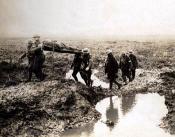


Do you mind if I sit here down by your grave side?
A rest for awhile in the warm summer sun,
I've been walking all day and I'm nearly done.
And I see by your gravestone that you were only 19,
When you joined the glorious fallen in 1916.
Well, I hope you died quick and I hope you died clean
Or, William McBride, was it slow and obscene?
Did they beat the drum slowly?
did they sound the pipes lowly?
Did the rifles fire o'er ye as they lowered you down?
Did the bugle sing 'The Last Post' in chorus?
Did the pipes play 'The Flowers o' the Forest'?
did they sound the pipes lowly?
Did the rifles fire o'er ye as they lowered you down?
Did the bugle sing 'The Last Post' in chorus?
Did the pipes play 'The Flowers o' the Forest'?
And did you leave a wife or a sweetheart behind?
In some faithful heart is your memory enshrined?
And though you died back in 1916
To that loyal heart are you always 19.
Or are you just a stranger without even a name,
Forever enclosed behind some glass-pane
In an old photograph torn and tattered and stained
And fading to yellow in a brown leather frame?
Did they beat the drum slowly?
did they sound the pipes lowly?
Did the rifles fire o'er ye as they lowered you down?
Did the bugle sing 'The Last Post' in chorus?
Did the pipes play 'The Flowers o' the Forest'?
did they sound the pipes lowly?
Did the rifles fire o'er ye as they lowered you down?
Did the bugle sing 'The Last Post' in chorus?
Did the pipes play 'The Flowers o' the Forest'?
Well, the sun it shines down on these green fields of France,
The warm wind blows gently and the red poppies dance.
The trenches are vanished now under the plough
No gas, no barbed wire, no guns firing now.
But here in this graveyard it is still No Man's Land
And the countless white crosses in mute witness stand.
To man's blind indifference to his fellow man
And a whole generation that was butchered and downed.
Did they beat the drum slowly?
did they sound the pipes lowly?
Did the rifles fire o'er ye as they lowered you down?
Did the bugle sing 'The Last Post' in chorus?
Did the pipes play 'The Flowers o' the Forest'?
did they sound the pipes lowly?
Did the rifles fire o'er ye as they lowered you down?
Did the bugle sing 'The Last Post' in chorus?
Did the pipes play 'The Flowers o' the Forest'?
And I can't help but wonder now, Willie McBride,
Do all those who lie here know why they died?
Did you really believe them when they told you the cause?
Did you really believe them that this war would end war?
But the suffering, the sorrow, the glory, the shame,
The killing, the dying - it was all done in vain.
For Willie McBride, it's all happened again
And again, and again, and again, and again.
Did they beat the drum slowly?
did they sound the pipe lowly?
Did the rifles fire o'er ye as they lowered you down?
Did the bugle sing 'The Last Post' in chorus?
Did the pipes play 'The Flowers o' the Forest'?
did they sound the pipe lowly?
Did the rifles fire o'er ye as they lowered you down?
Did the bugle sing 'The Last Post' in chorus?
Did the pipes play 'The Flowers o' the Forest'?


![[[https://ichef.bbci.co.uk/ace/standard/624/mcs/media/images/79906000/png/_79906152_williemcbride.png.webp|Willie McBride]](img/upl/_79906152_williemcbride.png.webp "[[https://ichef.bbci.co.uk/ace/standard/624/mcs/media/images/79906000/png/_79906152_williemcbride.png.webp|Willie McBride]")

[1976]
Testo di Eric Bogle
Musica ripresa dalla ballata popolare scozzese
Waly, Waly, but Love be Bonny
Lyrics and Music by Eric Bogle
Tune: Waly, Waly, but Love be Bonny
(Traditional Scottish folksong)
Paroles: Eric Bogle
Mélodie: Waly, Waly, but Love be Bonny
(Chanson traditionnelle écossaise)
Sanat: Eric Bogle
Sävel: Waly, Waly, but Love be Bonny
(Perinteinen skotlantilainen kansanlaulu)
QUICK INDEX OF VERSIONS AVAILABLE [15 languages up to now]
LT = Lyrics Translate (now Lyrics Translations)
Italiano 1 (Riccardo Venturi 2003) – Italiano 2 (Andrea Buriani 2015) – Tedesco (Hannes Wader 1980) - Francese 1 (Renaud 2009) – Francese 2 (Riccardo Venturi 2005) – Spagnolo 1 (Monsieur de Sans-Foy 2011) LT - Spanish 2 (Panzer Kanone 2014) LT – Neerlandese 1 (Strijdkoor Kontrarie 2000) – Neerlandese 2 (Wolverlei, 1981) - Retoromanzo (Emil Schavut 2005) – Gallese (Myrddin ap Dafydd 1979) – Greco (Gian Piero Testa 2012) - Portoghese – Svedese (Riccardo Venturi 2012) - Finlandese (Juha Rämö) - Russo 1 (Crimson King 2020) LT - Russo 2 (Valera Suk 2020) LT - Polacco (Azalia 2022) LT – Croato (Beekeeper) LT – Esperanto (Alessio 2022) LT
Italian 1 (Riccardo Venturi 2003) – Italian 2 (Andrea Buriani 2015) – German (Hannes Wader 1980) - French (Renaud) – French (Renaud 2009) – French 2 (Riccardo Venturi 2005 - Spanish 1 (Monsieur de Sans-Foy 2011) LT - Spanish 2 (Panzer Kanone 2014) LT – Dutch 1 (Strijdkoor Kontrarie 2000) – Dutch 2 (Wolverlei, 1981) - Rhaetoromance (Emil Schavut 2005) – Welsh (Myrddin ap Dafydd 1979) – Greek (Gian Piero Testa 2012) - Portuguese – Swedish (Riccardo Venturi 2012) - Finnish (Juha Rämö) LT - Russian 1 (Crimson King 2020) LT - Russian 2 (Valera Suk 2020) LT – Polish (Azalia 2022) – Croatian (Beekeeper) LT – Esperanto (Alessio 2022) LT
Una straordinaria canzone (forse una delle più belle canzoni contro la guerra mai scritte). Per il suo argomento, può essere considerata "gemella" di un'altra stupenda canzone, Vladslo di Willem Vermandere.
Dopo aver visitato i cimiteri di guerra francesi nei primi anni '70, Eric Bogle trasformò una canzone popolare scozzese in un drammatico colloquio fittizio (tecnica compositiva che usa assai di frequente) con il soldato semplice William McBride. Forse Bogle fu ispirato da una pietra tombale che aveva visto. A lungo si è creduto che il soldato ed il nome fossero fittizi.
Piet Chielens, coordinatore del Museo Bellico "In Flanders Fields" a Yprès, in Belgio, ed organizzatore dei concerti annuali per la pace nelle Fiandre, una volta ha controllato tutto il milione e settecentomila nomi di caduti registrati dalla Commissione di Guerra del Commonwealth, trovandovi dieci soldati semplici chiamati William McBride.
Tre di questi William McBride caddero nel 1916, due erano membri del Northern Irish Regiment tra i Royal Inniskilling Fusilliers, e morirono più o meno nello stesso posto durante la Battaglia della Somme. Il primo aveva 21 anni, il secondo 19. "La legge dei grandi numeri prevale anche sulla licenza più poetica", ha commentato Chielens.
Il diciannovenne soldato semplice William McBride è sepolto nel Cimitero Britannico di Authuille, presso Albert e Beaumont-Hamel, dove gli Inniskilling Fusilliers furono scaglionati come parte della 29a Divisione.
Piet Chielens, coordinator of the In Flanders Fields War Museum in Ypres, Belgium, and organizer of yearly peace concerts in Flanders, once checked all 1,700,000 names that are registered with the Commanwealth War Commission. He found no less than ten Privates William McBride.
Three of these William McBride's fell in 1916, two were members of the Northern Irish Regiment, the Royal Inniskilling Fusilliers, and died more or less in the same spot during the Battle of the Somme in 1916. One was 21, the other 19 years old. "The law of the greatest numbers does beat even the most poetical license", Chielens remarks.
The 19 years old Pte William McBride is buried in Authuille British Cemetery, near Albert and Beaumont-Hamel, where the Inniskilling Fusilliers were deployed as part of the 29th Division
C'est sûrement une des plus belles chansons contre la guerre de tous le temps qui nous vient d'Australie (mais l'auteur, Eric Bogle, est d'origine écossaise): "The Green Fields of France" (No Man's Land). Voici son incroyable histoire.
Après avoir visité les cimetières de guerre français au début des années '70, Eric Bogle a transformé une vieille chanson populaire écossaise, "Oh Waly, Waly" en une dramatique "conversation impossible" avec le soldat simple William McBride. Eric Bogle s'est peut-être inspiré d'une pierre tombale qu'il avait vu, et on a cru longtemps que le soldat et son nom étaient inventés.
Mais Piet Chielens, le directeur-coordinateur du Musée de Guerre "In Flanders Fields" d'Yprès, en Belgique, et aussi l'organisateur des "Concerts Flamands pour la Paix" (Vlaamse Vredesconcerten), a contrôlé une fois les 1.700.000 noms des soldats tombés enregistrés dans la liste officielle de la Commission de Guerre du Commonwealth. Il y a trouvé dix simples soldats au nom de William McBride.
Trois d'entre ces William McBrides sont tombés en 1916, l'an nommé dans la chanson d'Eric Bogle. En plus, deux faisaient partie du même régiment, le "Northern Irish Regiment" dans les "Royal Inniskilling Fusilliers", et ils tombèrent plus ou moins au même endroit dans la terrible bataille de la Somme. L'un avait 21 ans, l'autre 19. C'était le soldat de la chanson. "La loi des grands nombres l'emporte même sur la licence la plus poétique", a commenté monsieur Chielens.
Le soldat William McBride, âgé à jamais de dix-neuf ans, est enterré dans le Cimetière de Guerre britannique d'Authuille, près de Beaumont-Hamel, où les Inniskilling Fusilliers avaient été échelonnés avec la 29ème Division.